
Google Stitch in Sri Lanka: Prototype a Useful App
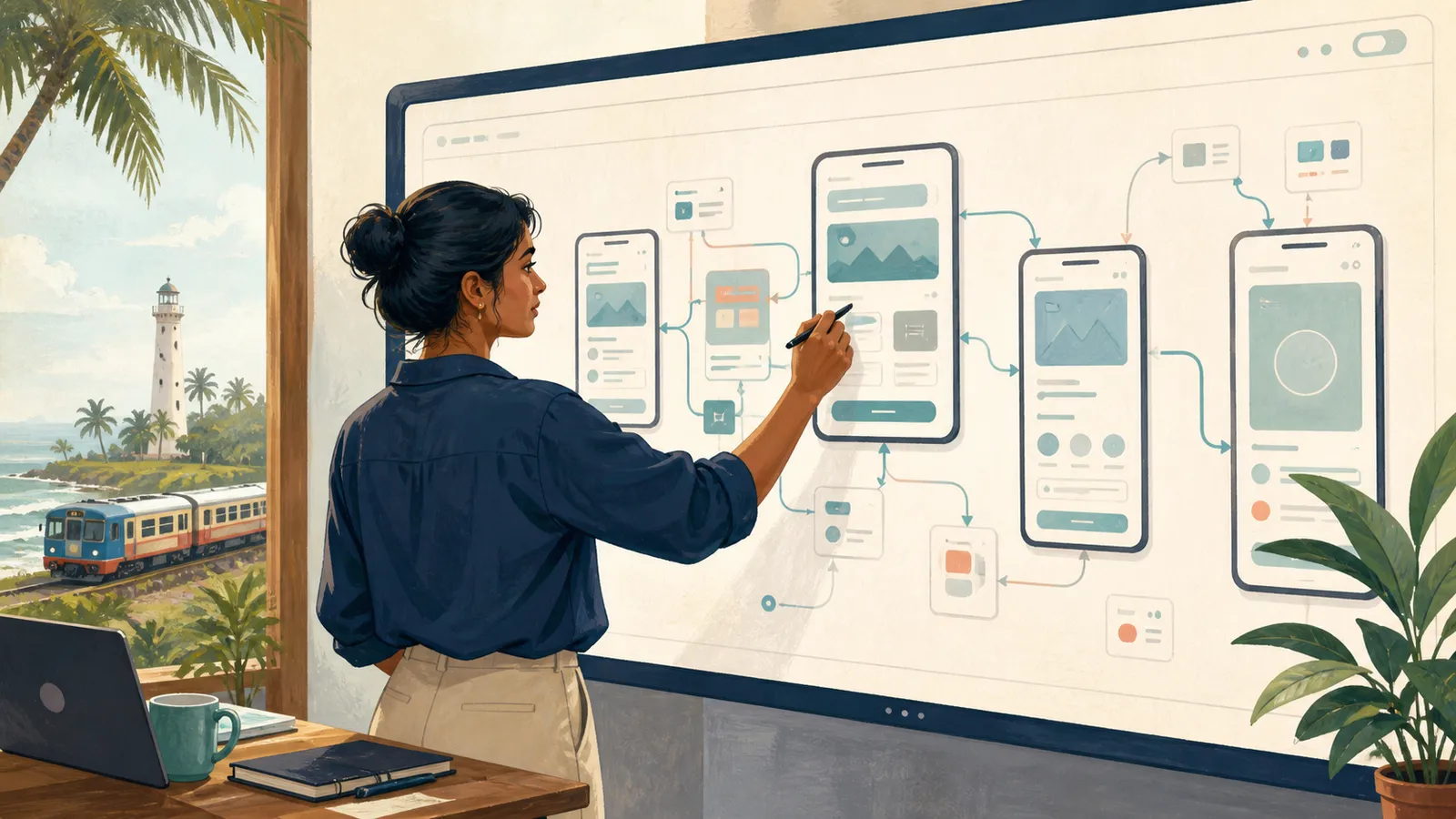
Google Stitch can help you explore an app interface quickly, but a useful prototype begins with a clear user task. For a Sri Lankan team, that might be booking a service, checking an order or requesting a quotation.
Google's March 2026 Stitch announcement describes generating high-fidelity interfaces from natural language and connecting screens into interactive prototypes. Treat the result as design material that still needs evaluation.
Define one complete task
Use a fictional repair-service app as an example. A customer needs to choose a service, describe the problem and submit contact details.
Write the intended result and the information required to reach it. Decide what is outside the prototype, such as live payments or technician scheduling.
If the team cannot agree on the task, generating more screens will not resolve the missing requirement.
Write a specific interface brief
| Brief element | Example |
|---|---|
| User | A customer using a phone |
| Task | Request a repair quotation |
| Required content | Service type, problem description and contact route |
| Important states | Empty, invalid, submitting and confirmed |
| Constraints | Clear labels and readable mobile layout |
An original prompt could ask for a mobile enquiry flow with three screens, visible field labels and a confirmation that explains what happens next.
Specify the content rather than asking only for a “modern, beautiful app.” Visual polish cannot compensate for a missing action or unclear instruction.
Inspect the generated journey
Follow the prototype from beginning to end. Check whether each button has an understandable destination and whether users can correct mistakes.
Look for missing states. What happens if the phone number is incomplete? What if submission fails? Does the confirmation imply that an appointment is booked when the user only requested a quotation?
These distinctions affect the product's meaning and should be resolved before development.
Test the design with a task
Ask someone to request a fictional repair without guiding them through the interface. Observe where they hesitate or misunderstand the next step.
Use a small set of observations to revise the design. Do not describe informal feedback as a representative survey of Sri Lankan users.
Consider language length and mobile constraints. A layout that looks tidy in English may need adjustment when Sinhala or Tamil text occupies different space.
For accessible form behaviour, consult the W3C forms tutorial. Keep labels, instructions and error feedback understandable.
Prepare a developer handover
Include the agreed flow, content, states and unresolved questions. Explain which behaviour is simulated and which requirements must be implemented.
A clickable prototype does not establish that authentication, storage, permissions or error recovery are working. Document those responsibilities separately.
Use the prototype to discuss decisions with the team, then update it when requirements change. Avoid handing over an attractive design that everyone interprets differently.
Does Stitch remove the need for a developer?
A prototype can accelerate discussion, but a live product still needs implementation, testing and operational decisions appropriate to its use.
Should you generate every screen immediately?
Start with the smallest complete journey. Add screens when the task or evidence justifies them.
Can you use the prototype in a portfolio?
Explain the tool's role and your own work in defining requirements, evaluating options and testing the journey.
What should you check before approving a design?
Confirm the main task, error states, content accuracy and handover requirements. Approval should reflect a usable flow, not only a pleasing screenshot.
Related guides
- UI UX Portfolio in Sri Lanka: Write a Clear Case Study
- Google AI Studio: First Prototype Guide for Sri Lanka
- No-Code Automation in Sri Lanka: Plan Your First Workflow
Browse the Sri Lanka work and technology guides for more practical application, AI and workplace projects.
Related articles

About the author
App Dev Sri Lanka prepared this guide with AI assistance, original examples and the linked primary sources. The collection was informed by Google Trends research for Sri Lanka on 2 September 2026. Illustrations depict fictional people. Examples are educational; this article is not a live vacancy notice or an employer endorsement.
Learn more about App Dev Sri Lanka